



Most contact centre leaders would say they understand their customers well enough. They run QA reviews, collect survey responses, tag calls manually, and pull performance reports. It feels thorough.
But Puzzel’s research with 1,505 CX professionals across the UK, Netherlands and Nordics paints a sharper picture. The typical contact centre analyses just 2 to 5% of customer interactions. The other 95% goes unexamined. That is not a minor gap. It is a structural blind spot.
The hidden cost of what you’re not seeing
When insights are missed, the consequences compound. 85% of customer complaints go unreported, meaning revenue-impacting issues remain invisible until they escalate. Agents spend up to 45 seconds manually tagging each call, and at least 30% of those tags contain errors. Conversations where agents need to look up information run 60 to 80% longer than average, and customers in those calls are more likely to express dissatisfaction.
Then there is the cost of repetition. 70% of contact centre costs come from avoidable, repetitive enquiries. For a centre spending £10M annually, that is potentially £7M tied up in inefficiencies that better insight could address.
These are not abstract numbers. They describe a contact centre that is working hard but operating without full visibility into what customers actually need.
Conversation data is becoming core infrastructure
The good news: CX leaders across Europe are recognising this. Puzzel’s State of Contact Centres 2026 report found that nearly eight in ten (78%) contact centres now use some form of AI or automation to analyse customer interactions. Of those, 37% have adopted advanced Conversational Intelligence solutions that identify trends, sentiment and intent in real time.
The shift is being driven by practical priorities. 94% of CX leaders say consolidating their tech stack is essential for improving performance, and the areas where they see the most value from AI are reporting and analytics, real-time guidance for agents, root-cause analysis and quality assurance.
“I see conversational analytics as a key capability, because every customer interaction is a learning opportunity. When we can truly understand empathy, good dialogue and customer sentiment, we gain the ability to grasp how customers feel, not just what they say.”
— Søren Kristian Steffensen, Analytics Manager at DSB
What changes when you analyse every conversation
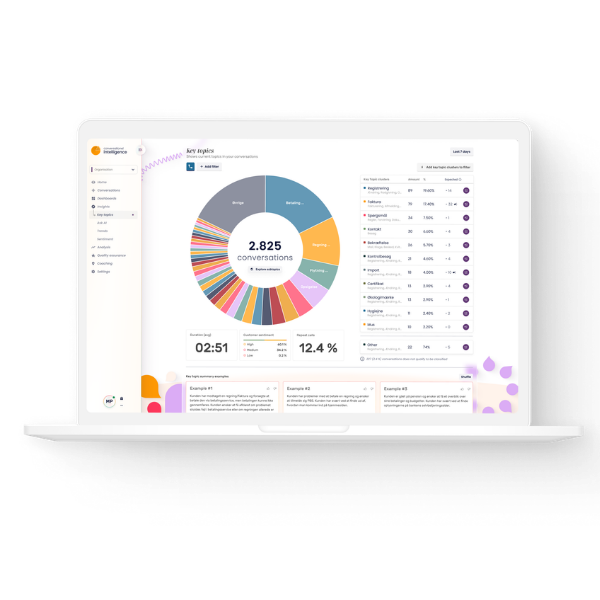
Puzzel’s Conversational Intelligence analyses 100% of customer interactions automatically, replacing manual tagging with AI-driven topic detection, sentiment analysis and trend identification. The difference shows up quickly in the numbers.
DSB, Denmark’s national rail operator, achieved 98% tagging accuracy and saw a 35% increase in positive customer sentiment after deploying Conversational Intelligence. They save over 400 hours annually on manual admin alone.
JFM, a Norwegian insurance provider, recorded a 62% increase in CSAT alongside a two-minute reduction in average handling time. Bredband2 in Sweden saw a 20% CSAT increase and a 44% improvement in win-back rates, with call durations dropping by 11%. And Telmore, a Danish telecoms provider, saves over 400 hours per month across its 80-agent team.
These results share a common thread. When contact centres stop relying on sample-based analysis and start working with complete data, they find the patterns that manual processes miss. Repeat call drivers become visible. Agent coaching gets targeted. And the insights reach beyond the contact centre, giving product, marketing and finance teams a clearer view of what customers actually experience.
Starting without boiling the ocean
The Puzzel approach is deliberately modular. You do not need to overhaul your entire operation on day one. Start by identifying where you are experiencing the most friction, whether that is repeat contacts, long handling times, inconsistent quality scores or limited visibility into why customers are calling.
Conversational Intelligence slots into the broader Puzzel CX Ecosystem alongside contact centre, workforce management and AI copilot capabilities. It works across voice, chat and email, and all data is processed within EU infrastructure with full GDPR compliance, which matters for organisations in regulated sectors such as insurance, energy, utilities and travel.
The bottom line
Contact centres that lead in 2026 will use AI to reduce repetitive work, surface knowledge in real time and turn conversations into decisions, all while preserving the human touch. The 98% of insights that most organisations are currently losing represent an enormous opportunity for those willing to act on them.
Explore how Conversational Intelligence can help.