



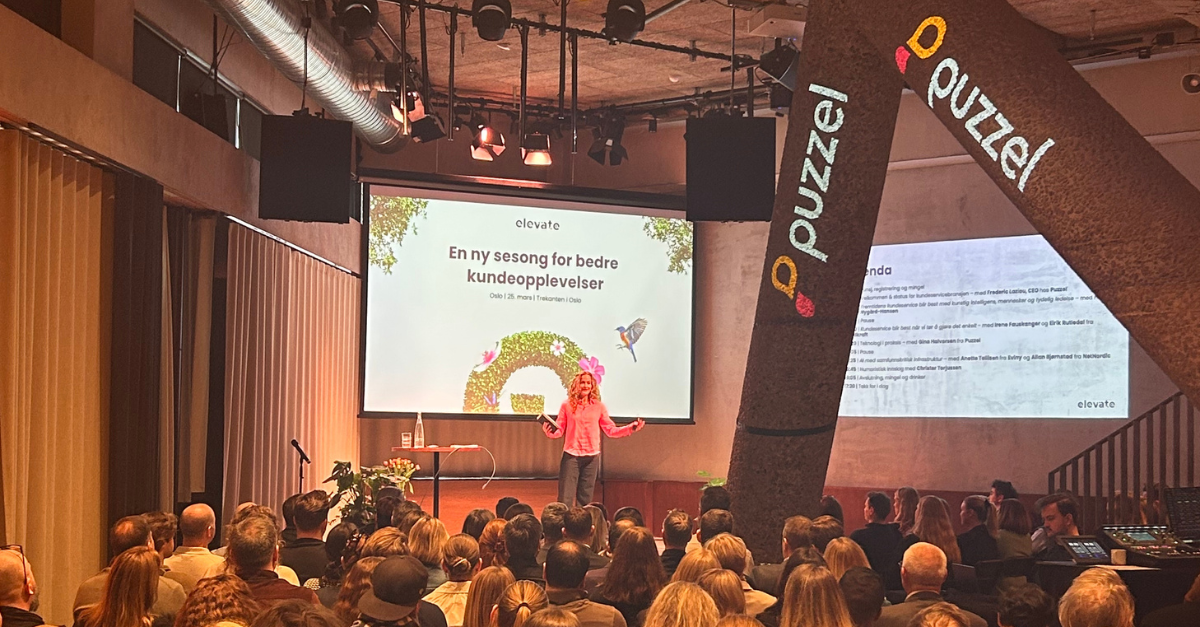
At Puzzel Elevate 2026 in Norway, speakers from Fjordkraft, Eviny and independent advisor Hans-Petter Nygård-Hansen tackled the same question from different angles: what does it actually take to deliver great customer service when AI enters the picture?
Most companies overestimate how good their service really is
Hans-Petter Nygård-Hansen opened with a stat that should make every CX leader pause. Research from Bain & Company shows that 80% of companies believe they deliver a superior customer experience. Only 8% of their customers agree. That gap, known as the Customer Experience Delivery Gap, is not closing on its own.
80% of companies think they deliver great CX
8% of customers agree
The reasons are familiar: organisations measure internal KPIs rather than customer effort, leadership rarely experiences the customer journey first-hand, and incentives reward efficiency over experience. Nygård-Hansen’s argument was clear. The problem is not a lack of technology. The problem is that most companies treat customer service as a department, not as an operating system for the entire business.
The companies that do get it right, the top 8%, share a pattern. They design the right value proposition for the right customers, they deliver it at the lowest possible system cost (not just the lowest contact centre cost), and they build institutional capabilities that can repeat this at scale. Bain calls it the Three D’s: Design, Deliver, Develop.
AI works best as a co-pilot, not on autopilot
Most companies are investing in chatbots. The ones that will win are those who invest in trust. When used uncritically, AI can reduce quality for even the most experienced agents. When used as an assistant, it accelerates the training of new agents and frees experienced agents to focus on complex queries.
Simplicity beats sophistication.
Irene Fauskanger and Eirik Rutledal from Fjordkraft, Norway’s largest electricity supplier, shared a philosophy that runs counter to the trend of adding more technology at every turn. Their principle: it is not the customer’s job to make things easy for Fjordkraft. It is Fjordkraft’s job to make things easy for the customer.
In practice, that means keeping their IVR as clean as possible, making it as simple as possible to get in touch, and building conversations that feel like calling home rather than navigating a system. Their CSAT word cloud tells the story: the most prominent word customers use is “hyggelig” (pleasant).
Zero customers in the queue, zero agents sitting idle.
Behind this apparent simplicity sits a deliberate operational model. Fjordkraft operates with a 0/0 vision: zero customers in the queue, zero agents sitting idle. They achieve this by multi-skilling their agents, consolidating vendors to reduce complexity, and carefully prioritising what they need to do, should do and could do. Fewer moving parts, more focus on the conversation.
Their five tips for the journey: set clear goals with a defined direction, dare to make choices, create new opportunities, stay curious, and look after each other.
AI implementation demands employee involvement from day one
Eviny, the largest renewable energy company on Norway’s west coast, shared their “KI Kundeservice 2.0” project, an ongoing effort to bring AI into a contact centre that handles enquiries for critical infrastructure.
Their approach is methodical. They moved from gut-feel operations to a data-driven contact centre using Puzzel for omnichannel routing, Power BI for real-time reporting, and Brillant for customer satisfaction measurement. The next step: rolling out AI across four areas. An internal AI assistant for knowledge and routines, Puzzel’s Live Summary for real-time call transcription and structured note-taking, AI-powered customer satisfaction analysis, and a voicebot as a future phase.
What stood out was their emphasis on security and employee buy-in. As a critical infrastructure provider, Eviny faces strict requirements around data, privacy and regulatory compliance. They treat streaming as equivalent to recording, require customer opt-in, and are considering dialogue with the Norwegian Data Protection Authority.
Wattson: a CoPilot agent designed to make agents’ working days simpler.
On the people side, they created a dedicated AI team, involved employee representatives (AMU) from the start, ran internal newsletters, and recruited voluntary testers. Their CoPilot agent, named “Wattson”, is designed to make agents’ working days simpler, speed up onboarding and free up more time for actual customer dialogue.
The thread that connects all three
Every speaker at Elevate 2026 Norway arrived at the same conclusion from a different starting point. Technology alone does not create great customer service. Fjordkraft builds simplicity by design. Hans-Petter Nygård-Hansen argues for trust over automation. Eviny puts people at the centre of its AI rollout.
For contact centre leaders weighing their next move, the message is consistent: start with the customer experience you want to deliver, involve your people early, and let AI serve that vision rather than define it.
Explore how Puzzel helps contact centres combine AI with human expertise.


.png)