

The UK has recently faced a number of challenges with significant implications for its citizens. Rising inflation, energy price increases, stagnating wages and economic uncertainty have hit the most vulnerable members of society the hardest, including many social housing residents.
Housing associations play a crucial role in providing a safe and secure environment for the people living in the 4.1 million social housing provided homes across the UK. Yet, these associations face their own unique set of challenges, including surging demand, stricter property efficiency standards, evolving regulations, and escalating expenses.
In this challenging landscape, housing associations need to review internal operations to create efficiencies and ensure regulatory compliance, ultimately leading to enhanced tenant experiences.
This is where the power of technology comes into play.
By embracing innovative CX solutions, housing providers can significantly increase efficiency and enhance human interactions. But technology alone isn’t the solution. It needs to be balanced with a human touch. For providers, this means understanding the unique needs of tenants, delivering personalised experiences, and providing proactive and timely assistance. It means streamlining processes, making information easily available, and addressing the way housing associations respond to issues inside and outside the home.
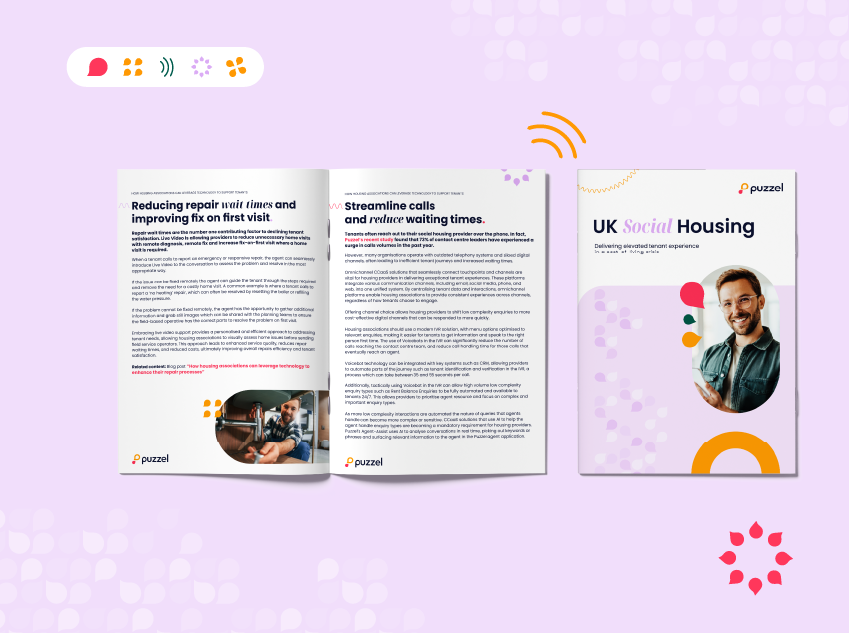
In this eBook, you’ll read about the challenges facing the housing sector, including the impact of the cost-of-living crisis, and how it’s affecting both tenants and housing associations. And, you’ll discover how modern technology solutions can help housing associations optimise internal processes and provide proactive support for tenants when they need it most.
CURRENT MARKET OVERVIEW: The cost-of living crisis
The cost of living crisis has impacted citizens across the UK with annual inflation peaking at 11.1% in October 2022 - a level not seen in over four decades. This rise in inflation has led to energy, food and fuel prices reaching record highs. Adding wage stagnation and increasing living costs to the situation, many households are placed in increasingly difficult situations.
Today, the inflation rate is declining, however, this means that prices are rising at a slower rate than before; not that price levels are actually falling. A recent report by Financial Fairness Trust estimates that 4.8 million households are currently facing ‘serious financial difficulties’ - an increase of 2 million since 2021.
Rising energy bills and food prices are the main contributors to rising living costs. Between January 2022 and January 2024, food prices surged by a staggering 24.8%. In comparison, it took over 13 years, from October 2008 to January 2022, for average food prices to rise by the same amount. As a result, a JRF research revealed that 5.2 million low-income households have been forced to cut down on meals or go hungry due to lack of money for food.
Additionally, some 3.2 million haven’t been able adequately heat their homes since the start of 2022 due to increased energy prices. In February 2022, the inflation rates for gas and electricity reached their highest levels since early 2009, with gas experiencing a 28.1% increase and electricity an 18.8% increase. Consequently, many people are now living in cold houses, which heightens the threat of mould and damp.
The financial crisis extends further, as low-income families are falling behind on payments with arrears at an average amount of £1,600. This has led people to take on new debt to cover the basics. In fact, low-income households took on £12.5 billion of new debt in 2022 alone. Furthermore, the study by JRF found that 54% of social renters are in at least one type of arrears, compared to 19% of those who own their homes outright. These statistics underscore the urgent need for tenant support and guidance from housing providers.
MOULD AND DAMP: Side-effects of the cost-of-living crisis
In an effort to save on energy costs, many households have resorted to cutting back on heating, with 57% of all households and a staggering 76% of those in serious financial difficulty either avoiding turning on the heating or reducing its use. This practice comes with potential risks to health and well-being. Studies have shown that approximately 21.5% of excess winter deaths can be attributed to cold homes. Furthermore, the NHS spends £2.5 billion annually on treating illnesses directly linked to living in cold, damp, and unsafe homes, ultimately adding more pressure on Public Sector services in the UK.
Today, the study by Financial Fairness Trust, found that 32% of all households had problems with damp, mould or condensation, rising to 51% of those in serious financial difficulty. Addressing the issue of damp and mould in homes is critical to ensuring the well-being and safety of individuals and families. By implementing proactive strategies and leveraging technology, housing associations can play a pivotal role in preventing and addressing these challenges, ultimately elevating the tenant experience and promoting healthier living environments.
The crucial role of housing associations
Amidst the economic crisis, housing associations play a critical role in the lives of tenants, ensuring safe and affordable housing for over 4.4 million households.
Building trust between housing associations and tenants is now more important than ever. Simultaneously, there is a pressing need for housing associations to find ways to minimise costs. The surge in inflation has drastically increased the costs of materials, land, and maintenance, forcing housing associations to re-think spending priorities. As a result of the current crisis, the demand for social housing is increasing with about 1.29 million households being on waiting lists for social housing in England, the highest number since 2016.
Housing Associations need to find solutions that ensure the well-being of both tenants and staff, and at the same time ensure costs are optimised to achieve best value for money.
Now, let us explore how housing associations can leverage modern Cloud Contact as a Service (CCaaS) technology to enhance operational efficiency and deliver exceptional tenant experiences amidst the challenges posed by the cost-of-living crisis.
How housing associations can leverage technology to support tenants
By leveraging modern CX technology, housing providers can streamline their internal processes, ultimately leading to better support and experiences for tenants. This means quicker response times, more efficient workflows, and a stronger ability to address the unique needs of each tenant. With modern technology housing providers can begin to drive improved outcomes and re- focus on addressing the deeper underlying challenges.
For tenants, this means services are more accessible, providers are more informed to anticipate their needs, and can react quicker to emotive issues such as rent arrears and repairs. In order to deliver these benefits providers must invest in modern Omnichannel CCaaS platforms, however, these platforms will not address the challenges and deliver the above outcomes in isolation. Providers need to consider how the CCaaS solution will integrate with the wider technology stack which for some providers, includes hundreds of different applications.
As a vendor that is committed to extending the value delivered from the contact centre, Puzzel enables deep integration with Housing Management Systems, CRM, Rent Arrears, Appointment Scheduling and other commonly used systems via the Universal Adaptor. This approach offers a single pane of glass view into the plethora of systems creating connected experiences for agents, tenants, and allowing workflows to be automatically triggered for maximum efficiencies.
The next chapters offer insights into how Puzzel’s European leading CX solution elevates tenant experiences, enhances the agent experience and helps providers to drive the economic benefit required to deliver sustainable housing.
Optimising tenant support through enhanced self-service with chatbots
In times of stress, empowering tenants to easily find information on their own is paramount. It not only ensures faster support but also leads to greater tenant satisfaction. By implementing user-friendly self-service options, such as modern AI chatbots, tenants can get support easily, 24/7. This not only empowers tenants but also reduces the volume of low complexity enquiry types such as rent balance enquiries, improving agent workload, and reducing agent attrition rates.
Here are some benefits of utilising modern chatbots in the contact centre:
- The tenant journey starts online: FAQs relating to common queries such as damp and mould guidance can all be found online, however, tenants cannot always easily find the information they need. Proactive chatbots can detect what the tenant needs based on their website interaction history and guide the tenant to the relevant information. Not only that, chatbots can guide the tenant through online processes such as completing a web form, ensuring the tenant has the support required to self-service their enquiry.
- 24/7 availability for swift responses: By leveraging Natural Language Processing (NLP) and Machine Learning (ML), chatbots can understand and respond to tenant enquiries in real-time. This automation streamlines the process, reducing response times and allows agents to focus on more complex and value-added tasks, such as discussing a payment plan with a tenant who is at risk of falling into arrears. Via chatbots, tenants can get immediate answers to their enquiries, eliminating the need for lengthy wait times or phone calls.
- Seamless transition: Modern chatbots can seamlessly transfer the tenant to a live agent if needed. In addition to facilitating this smooth transition, chatbots have the ability to capture and retain all relevant data and chat history. This ensures that when the tenant is connected with a live agent, they have a concise summary of the conversation, making the agent better equipped to give a fast reply.
Bonus tip: For chatbots to be most valuable, they should be regularly updated with up- to-date information that is relevant to tenants. To achieve this, housing providers can pull information from CRM and other systems, or use external facing knowledge base. Most importantly, chatbots should not replace agents, but complement them, seamlessly integrating with the customer journey.
Proactively addressing damp and mould
The recent introduction of Awaab’s Law is a significant shift in the management of damp and mould issues in social housing, placing new obligations on both landlords and tenants to ensure safer and healthier living conditions. Landlords are now legally bound to promptly investigate and rectify any damp and mould concerns, while tenants are encouraged to report these problems with detailed information for effective resolution.
To facilitate seamless reporting and timely resolution, housing associations can leverage Internet of Things (IoT) investments by automating outbound contact when a damp and mould event has been identified.
If the home is consistently below an optimum temperature, or where moisture levels are above expected levels, IoT devices will alert the CCaaS platform via the Universal Adaptor. An action is created in the Puzzel platform and depending upon the pre-programmed logic-based workflows, an outbound communication to the tenant will follow. The outbound communication can be determined by a number of variables, including the event type, frequency and by personal variables such as the tenant’s vulnerability status or age.
Recognising homes that are consistently below the optimum temperature will allow providers to identify tenants that may be struggling with rising fuel costs and provide financial guidance and support to prevent future damp and mould cases arising.
Where damp and mould is present, providers can respond quickly to ensure they are meeting the responsibilities as defined in Awaab’s Law, allowing providers to promptly investigate and address damp and mould cases before they become more sinister and costly to resolve.
This approach ensures IoT alerts are not only raised but actioned, triggering support workflows that can be processed across all channels such as SMS, Voice, Chatbot and WhatsApp.
Reducing repair wait times and improving fix on first visit
Repair wait times are the number one contributing factor to declining tenant satisfaction. Live Video is allowing providers to reduce unnecessary home visits with remote diagnosis, remote fix and increase fix-on-first visit where a home visit is required.
When a tenant calls to report an emergency or responsive repair, the agent can seamlessly introduce Live Video to the conversation to assess the problem and resolve in the most appropriate way.
If the issue can be fixed remotely the agent can guide the tenant through the steps required and remove the need for a costly home visit. A common example is where a tenant calls to report a ‘no heating’ repair, which can often be resolved by resetting the boiler or refilling the water pressure.
If the problem cannot be fixed remotely, the agent has the opportunity to gather additional information and grab still images which can be shared with the planning teams to ensure the field-based operative has the correct parts to resolve the problem on first visit.
Embracing live video support provides a personalised and efficient approach to addressing tenant needs, allowing housing associations to visually assess home issues before sending field service operators. This approach leads to enhanced service quality, reduces repair waiting times, and reduced costs, ultimately improving overall repairs efficiency and tenant satisfaction.
Related content: Blog post “How housing associations can leverage technology to enhance their repair processes”
Streamline calls and reduce waiting times
Tenants often reach out to their social housing provider over the phone. In fact, Puzzel’s recent study found that 73% of contact centre leaders have experienced a surge in calls volumes in the past year.
However, many organisations operate with outdated telephony systems and siloed digital channels, often leading to inefficient tenant journeys and increased waiting times.
Omnichannel CCaaS solutions that seamlessly connect touchpoints and channels are vital for housing providers in delivering exceptional tenant experiences. These platforms integrate various communication channels, including email, social media, phone, and web, into one unified system. By centralising tenant data and interactions, omnichannel platforms enable housing associations to provide consistent experiences across channels, regardless of how tenants choose to engage.
Offering channel choice allows housing providers to shift low complexity enquiries to more cost-effective digital channels that can be responded to more quickly.
Housing associations should use a modern IVR solution, with menu options optimised to relevant enquiries, making it easier for tenants to get information and speak to the right person first time. The use of Voicebots in the IVR can significantly reduce the number of calls reaching the contact centre team, and reduce call handling time for those calls that eventually reach an agent.
Voicebot technology can be integrated with key systems such as CRM, allowing providers to automate parts of the journey such as tenant identification and verification in the IVR, a process which can take between 35 and 55 seconds per call.
Additionally, tactically using Voicebot in the IVR can allow high volume low complexity enquiry types such as Rent Balance Enquiries to be fully automated and available to tenants 24/7. This allows providers to prioritise agent resource and focus on complex and important enquiry types.
As more low complexity interactions are automated the nature of queries that agents handle can become more complex or sensitive. CCaaS solutions that use AI to help the agent handle enquiry types are becoming a mandatory requirement for housing providers. Puzzel’s Agent-Assist uses AI to analyse conversations in real time, picking out keywords or phrases and surfacing relevant information to the agent in the Puzzel agent application.
Providing agents with relevant and accurate information during an interaction reduces average call handling time, empowers the agent with the information to resolve the enquiry without needing to place the caller on hold or transfer to colleagues, increases first call resolution and ultimately deliver consistent experiences. AI Powered Agent Assist is also available to agents when managing interactions on digital channels like Webchat, Social Media, WhatsApp, Email and 2-way SMS.
By centralising communication channels with a single platform that offers a single data lake providing rich information for all tenant touchpoints, housing providers can better understand tenants, engage with them effectively, and continuously optimise their journeys.
Related content: Blog post “Enhancing operations and tenant satisfaction in Housing Associations”
Conclusion
Tenants and housing associations in the UK are currently facing many challenges. Rising inflation, along with increased energy and food prices, has pushed many households into financial distress. Housing providers have played a crucial role for many families for generations, and in these challenging times, the role of the housing provider extends far beyond the walls of the home. However, providers are also facing pressures from the current economic crisis, in addition to the demands of new regulatory compliance.
By embracing modern technology solutions, housing associations can optimise internal processes and deliver proactive support to tenants. From leveraging Live Video to deploying AI-driven chatbots for enhanced self-service, CCaaS can help housing associations in transforming tenant experiences. Embracing innovative solutions and maintaining a balance between technology and human empathy, housing associations can navigate the complexities of the cost-of-living crisis while fostering stronger, more resilient communities.
At Puzzel, we understand the immense pressure on housing associations to navigate the current landscape while striving to deliver great customer experience to their tenants.
Are you ready to explore how CCaaS can transform tenant experience, improve TSM results and optimise resources across your organisation? Book your free consultation today.