

The ever-evolving state of customer experience
AI is making a significant impact on CX operations, but it’s also pushing contact centres to adapt. As customer expectations grow, contact centres are stepping up—adopting new technologies, rethinking strategies, and finding smarter ways to deliver faster, more personalised support.
The State of Contact Centres 2025 report takes a closer look at how CX leaders are navigating these changes. Based on insights from 1,505 CX leaders and contact centre professionals across Europe, it reveals the trends, challenges, and opportunities shaping the future of the industry.
From using AI to boost efficiency and automate repetitive tasks to prioritising agent wellbeing
and skills development, this report uncovers how organisations are meeting growing demands, all while balancing technology with human empathy.
Here, you’ll gain practical insights and forward- thinking strategies from your peers, contact centre leaders, offering a clearer vision of how to navigate the role of AI and human expertise in CX—and prepare your contact centre for what’s next.
METHODOLOGY
OnePoll, on behalf of Puzzel, conducted an online survey of 1,505 contact centre professionals across the United Kingdom, Netherlands, Sweden, Norway, and Denmark.
Executive Summary
AI and automation as core drivers of efficiency
Reducing wait times and boosting first contact resolution are top priorities. CX leaders are adopting AI to speed things up by automating routine tasks and streamlining operations.
AI-powered insights for better decisions
Conversational analytics provide CX leaders with actionable insights into customer behaviour and operations. These tools are driving smarter decisions.
-
68% of CX leaders calling AI-driven conversational analytics critical for improving customer interactions.
Balancing tech and human touch
Hybrid models are the way forward.
-
43% of CX leaders believe blending AI’s efficiency with human empathy is the future of customer experience.
Building confidence in chatbots
Chatbots are earning more trust. 61% of CX leaders are confident in their accuracy, and 57% believe their customers are comfortable interacting with AI chatbots.
Empowering and upskilling agents
With skills shortages and high turnover, empowering agents is a top priority.
-
65% of CX leaders agree AI tools, like AI assistants, can reduce agent burnout and boost agent performance, making AI a powerful tool to support agents.
Personalisation at scale
As customer expectations grow, personalisation is key. AI and data insights empower contact centres to deliver tailored support across channels. In fact, 77% of CX leaders say AI is crucial for personalisation, and 56% of senior managers believe AI’s ability to detect and respond to customer emotions in real-time will be a game-changer for customer service.
CX leaders are turning challenges into opportunities
Contact centres are under pressure. Rising customer expectations, lack of skilled personnel, and fragmented workflows are making it harder to keep up. For many, efficiency is held back by manual, time-consuming tasks and high interaction volumes, often leaving agents bogged down by administrative work. Combined with high agent turnover and limited budgets, maintaining high-quality service is no small feat.
But with challenges come opportunities. CX leaders are rethinking how they operate, turning obstacles into chances to innovate, grow, and work smarter.
— Over the next years, they are prioritising speed, personalisation, and agent empowerment.
Customers expect quick, personalised interactions, and getting it right is essential. Many contact centres are adopting AI-driven tools like chatbots and virtual assistants to optimise workflows, reduce wait times, and improve first-contact resolution. This not only helps manage growing customer demands but also reduces operational costs, making it a win-win for both businesses and customers.
At the heart of these changes is a commitment to agent empowerment. CX leaders are providing agents with the right tools, training, and support to enhance their skills. And as AI takes over repetitive tasks, agents can focus on more meaningful, rewarding work. This shift not only enhances performance but also leads to higher job satisfaction, reducing burnout and improving retention.
CX leaders who embrace these priorities can navigate current challenges and position their contact centres for long-term success—giving them the edge needed to stay ahead of the competition and deliver exceptional customer experiences.
Biggest challenges for contact centres:
-
Lack of skilled personnel
-
Managing high customer volumes
-
Limited budgets
-
Manual inefficiencies
-
Agent turnover
-
Customer churn
Top priorities for the next two years:
-
Improving first contact resolution and reducing handling time
-
Delivering personalised customer interactions
-
Investing in agent training and development
-
Reducing operational costs
-
Strengthening data protection and security
-
Expanding AI and automation usage
AI brings new ways of working, leaving a gap for contact centre teams
The role of agents has changed significantly in recent years. With rapid advancements in AI and rising customer expectations, they’re now required to balance traditional customer service skills with new technical abilities. But are they ready for the challenge?
— Our survey reveals that 29% of contact centres report a lack of skilled personnel, rising to 34% for companies with 500-999 employees.
Many agents, already facing high workloads, are
now expected to manage new technologies. As AI continues to make its way into contact centres, they’ll need to not only use AI tools effectively but also craft AI prompts and adapt to new ways of delivering services —all while maintaining exceptional service standards. This shift presents a big challenge— especially for contact centres that are already struggling to fill skill gaps in their teams.
Adding to this, agents work in fast-paced, high- pressure environments, often dealing with repetitive tasks, inefficient workflows, and high interaction volumes. These factors contribute to burnout, stress, and, ultimately, high turnover rates—a challenge faced by 22% of contact centres, rising to 30% for businesses with 500-999 employees, according to our survey. This is costing organisations heavily in recruitment, training, and lost productivity. In fact, in some markets, the cost of replacing a single agent can reach up to €10,000 or more per hire.
“After implementing Puzzel’s unified CX platform, businesses saw a significant boost in retention. Puzzel helped create a competency framework and career progression, empowering agents, increasing job satisfaction, and increasing employee tenure from under six months to 3.5 years.”
Source: FORRESTER CONSULTING TOTAL ECONOMIC IMPACTTM STUDY OF PUZZEL.
-
15% - boost in agent productivity
-
163% - improvement in employee retention
-
10.3M - significant agent productivity gains
Trend 1: CX leaders are making agent wellbeing a top priority to improve performance and satisfaction
The mentioned statistics paint a clear picture: contact centres need to invest in their agents’ skills and wellbeing. So, what are CX leaders doing to create a work environment where agents feel empowered, skilled and engaged?
-
65% of CX leaders agree that AI support tools, such as AI assistants, can enhance agent performance and reduce burnout.
This number rises to 73% for businesses with 250-499 employees. By streamlining workflows and providing agents with quick access to the information they need, AI helps agents make faster, more informed decisions, reducing stress and improving customer satisfaction. AI tools like chatbots can handle repetitive tasks, allowing agents to focus on more complex and meaningful work.
Yet, to fully unlock these benefits, agents need proper training in how to use AI effectively—whether it’s crafting the right AI prompts or interpreting AI suggestions. Positively, agent training and development are seen as top priorities for CX leaders over the next two years. This focus will ensure agents are confident in using AI to its full potential, while also helping them adapt to changes in technology and customer expectations.
Providing agents with ongoing development opportunities and a supportive environment is just as critical as giving them the tools they need to succeed. Investing in mental health resources, flexible work options, and recognition programs can reduce stress and burnout while boosting morale and engagement.
Here’s how AI can support agents:
-
Optimise workflows: AI tools like virtual assistants can handle tasks such as scheduling or ticket routing, allowing agents to focus on higher-priority cases.
-
Improve decision-making: AI-driven knowledge bases, such as those integrated into chatbots, provide agents with immediate access to up-to- date information, improving response times and accuracy when assisting customers.
-
Better efficiency: AI chatbots or voice assistants can quickly resolve common customer queries, like account balance checks or order statuses, leaving agents to address more complex or sensitive issues.
-
Reduce burnout: By automating routine tasks, AI helps reduce cognitive load and stress. For example, AI can automatically tag and categorise customer queries, enabling agents to quickly prioritise urgent issues
Related content:
A practical guide to contact centre agent happiness.
Trend 2: AI as a valuable tool to optimise workflows and speed up processes
Constant availability through smartphones and the internet has led to customers expecting
things instantly—whether it’s immediate access to information, same-day deliveries, or seamless streaming. This “right-now” culture has shaped their expectations for customer service, too. In fact, according to HubSpot, 90% of customers say an immediate response is crucial to their experience. CX leaders are responding to this trend by placing improving first contact resolution rates and reducing average handling time as key priorities over the next 2 years.
However, they also recognise it’s not a simple task. Our survey shows that a quarter of CX leaders report struggling with high customer volumes and increased demand, a challenge that grows to 36% for mid-sized companies with 500–999 employees. On top of this, manual, time-consuming processes continue to slow operations, with 32% of mid-sized organisations highlighting them as a major obstacle. These inefficiencies not only slow response times but also lead to agent frustration and burnout, ultimately affecting the customer experience.
To overcome these challenges, contact centres leaders are turning to AI and automation to optimise workflows, reduce manual tasks, and boost efficiency. With 66% of CX leaders in last year’s report identifying AI as a key focus for 2024, it’s clear that automation remains at the heart of their strategies.
Over the next two years:
-
37% of CX leaders believe AI will enable 24/7 service in their contact centres, ensuring customers can access support whenever they need it. For large enterprises (1,000+ employees), this figure rises to 46%.
-
34% of CX leaders see AI driving faster response times and improving average handling time, climbing to 38% for larger organisations.
-
27% of CX leaders believe AI will bring automation to reduce routine tasks, freeing up agents to focus on more complex interactions. This number rises to 31% for organisations with 500-999 employees. Next to this, many CX leaders believe AI can cut costs, especially as many are dealing with tight budgets.
-
27% anticipate significant cost savings through automation, with larger enterprises reporting an even higher expectation at 30%.
By reducing operational expenses while boosting productivity, AI helps contact centres achieve their goals without compromising on quality.
When asked, what do you believe AI can bring to your contact centre over the next 2 years, CX leaders say:
-
24/7 service availability for round-the-clock support - 37%
-
Faster response times and improved handling time - 34%
-
Cost savings through automation - 27%
-
Automating routine tasks to reduce manual work - 27%
-
Improved data and analytics - 24%
-
Enhancing agent productivity with real-time AI support - 21%
-
Handling complex customer queries more effectively - 20%
Trend 3: We're getting more comfortable with chatbots
AI chatbots are no longer just a nice-to-have—they’re becoming essential tools for modern contact centres. While some businesses are still catching up, many are taking action. Last year’s survey revealed that 64% of CX leaders planned to prioritise chatbots for customer service in 2024. For those who haven’t yet implemented chatbots, 36% of CX leaders believe they will implement AI chatbots in 2025, rising to 41% among businesses with 50-249 employees. At the same time, confidence in AI chatbots is steadily rising.
-
61% of CX leaders express trust in chatbots’ accuracy and reliability to handle complex queries.
This confidence is even stronger in mid-sized companies (250–999 employees), where over 70% of leaders believe in the technology’s potential to handle sophisticated interactions effectively.
It’s not just businesses that are warming to chatbots— many customers are, too. Across all respondents, almost six in ten (57%) respondents believe their customers are comfortable with interacting with AI chatbots, rising to 69% for businesses with 250-499 employees. This rises to 65% in Sweden but drops to 50% among UK respondents.
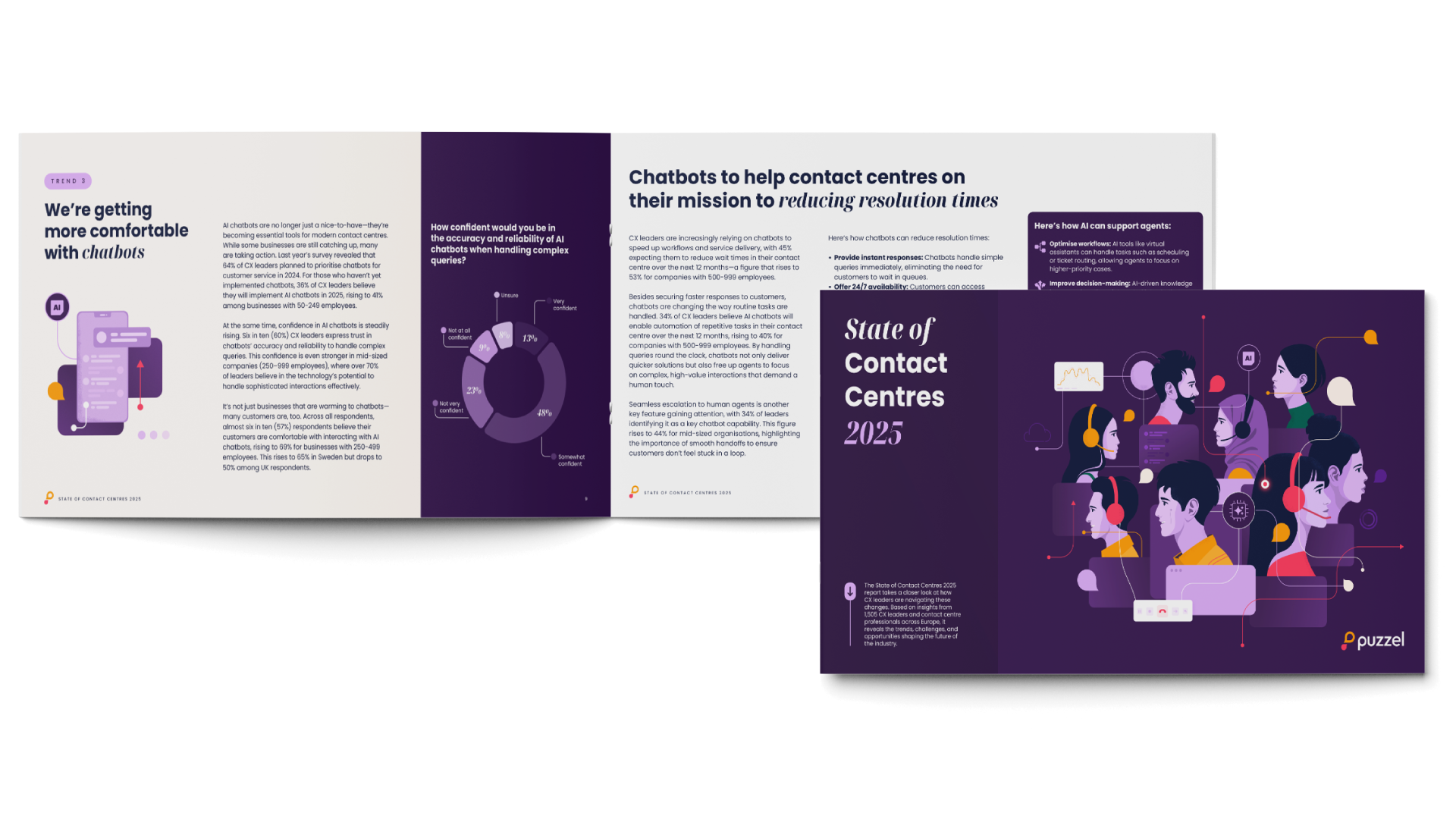
How confident would you be in the accuracy and reliability of AI chatbots when handling complex queries?
-
Unsure - 8%
-
Very confident - 13%
-
Not at all confident - 9%
-
Not very confident - 23%
-
Somewhat confident - 48%
Chatbots to help contact centres on their mission to reducing resolution times
CX leaders are increasingly relying on chatbots to speed up workflows and service delivery, with 45% expecting them to reduce wait times in their contact centre over the next 12 months—a figure that rises to 53% for companies with 500-999 employees.
Besides securing faster responses to customers, chatbots are changing the way routine tasks are handled. 34% of CX leaders believe AI chatbots will enable automation of repetitive tasks in their contact centre over the next 12 months, rising to 40% for companies with 500-999 employees. By handlingqueries round the clock, chatbots not only deliver quicker solutions but also free up agents to focus on complex, high-value interactions that demand a human touch.
Seamless escalation to human agents is another key feature gaining attention, with 34% of leaders identifying it as a key chatbot capability. This figure rises to 44% for mid-sized organisations, highlighting the importance of smooth handoffs to ensure customers don’t feel stuck in a loop.
Here’s how chatbots can reduce resolution times:
-
Provide instant responses: Chatbots handle simple queries immediately, eliminating the need for customers to wait in queues.
-
Offer 24/7 availability: Customers can access support anytime, resolving issues outside of regular business hours.
-
Smooth handoffs to agents: AI chatbots transfer challenging queries to human agents with full context, reducing time spent on explanations.
-
Streamline information retrieval: Chatbots quickly fetch FAQs, account details, or troubleshooting guides, empowering customers with faster answers.
-
Improve workflows: By handling repetitive tasks like password resets or order tracking, chatbots free agents to focus on high-priority interactions.
RELATED CONTENT:
How AI chatbots reduce resolution times and enhance CX in customer support.
Trend 4: CX leaders to deliver on the promise of personalised interactions
Quick resolutions are just one piece of the puzzle. Delivering exceptional customer service means creating an experience that’s fast, effective, and personalised. It’s no surprise that personalisation is a top priority for CX leaders in the years ahead.
And AI is here to help them deliver on that promise, too. In fact, 77% of CX leaders believe AI will be key to creating personalised customer experiences, jumping to 88% for businesses with 250-499 employees. This is a clear signal that personalisation is becoming an essential part of customer service strategies.
One way AI is helping is by tailoring interactions based on customer data and history. 34% of CX leaders identify this as a top capability to develop
in AI chatbots—a number that climbs to 37% among enterprises with more than 1,000 employees. However, the potential of AI goes beyond surface level personalisation. Generative AI, for example, opens up new possibilities, from crafting unique customer interactions to producing tailored content. In fact, a third of CX leaders believe generative AI will have the biggest impact on contact centres over the next five years
What’s more is AI’s ability to detect and respond to customer emotions, such as frustration, in real-time. More than a quarter (27%) of respondents see this as a game-changer for customer service. This rises to 56% among Senior Managers and 40% among those with 500-999 employees. 42% of CX leaders remain intrigued but cautious, noting it as a concept that needs more exploration.
-
56% of senior managers said the potential for AI to detect and respond to customer emotions in real-time will be a game-changer for customer service
The focus on personalisation reflects a broader shift in customer expectations, with organisations recognising that success lies in balancing efficiency with empathetic, human-like interactions. Whether through generative AI, emotion detection, or advanced chatbots, AI is set to redefine personalisation in contact centres, creating opportunities to forge deeper connections with customers.
How do you feel about the potential for AI to detect and respond to customer emotions in real-time?
-
27% - It will be a game-changer for customer service
-
42% - It’s an interesting concept, but I need more information
-
22% - I’m sceptical of AI’s ability to detect emotions accurately
-
8% - I don’t believe it will be useful
Trend 5: Conversational analytics will enable smarter customer service for CX teams
By 2025, 68% of CX leaders believe AI-driven conversational analytics will be critical—if not essential—for improving customer service. This rises to 81% for businesses with 250-499 employees and 77% for those with 500-999 employees. This is driven by the increasing demand for real-time insights and the ability to understand and respond to customer needs more effectively.
AI-driven conversational analytics not only boost the efficiency of contact centres but also empower customer service teams to anticipate customer needs and drive better outcomes. By analysing customer interactions in real-time, AI can offer immediate insights to both agents and managers, ensuring that issues are resolved faster and more accurately.
Whether through analysing voice and text interactions or providing agents with instant feedback, conversational AI is enabling contact centres to move closer to truly personalised, proactive service.
Key benefits of conversational analytics:
-
Real-time insights: Conversational AI can analyse voice and text interactions instantly, providing agents with the context they need to respond effectively and efficiently.
-
Instant feedback for agents: AI can provide agents with real-time feedback during calls, offering suggestions for improvement or even suggesting next steps, leading to enhanced agent performance and faster resolutions.
-
Personalised customer service: By understanding customer sentiment and context, conversational analytics help agents tailor responses, delivering a more empathetic and relevant experience.
-
Proactive issue resolution: AI can identify recurring issues or emerging trends from conversations and alert agents or managers before problems escalate, enabling more proactive support.
-
Improved decision-making: With analytics providing a deeper understanding of customer interactions, managers can make data-driven decisions to improve service quality, optimise workflows, and adjust strategies accordingly.
RELATED CONTENT
Conversational Intelligence: A Definitive Guide to Unlocking Contact Centre Efficiency
What about voicebots?
Voice-activated assistants are transforming how people interact with technology, and contact centres are no exception. AI-driven voice technologies like voicebots are opening up new possibilities, especially as CX leaders report increasing volumes of incoming calls. But with modern voicebots still relatively new to the industry, the question remains: are contact centres ready to fully embrace their potential?
Our survey indicates growing confidence in voicebots. A quarter of CX leaders (25%) believe AI-powered voicebots will have the biggest impact on contact centres over the next five years, rising to 31% for businesses with 500–999 employees. Additionally, 22% plan to implement voicebots in 2025, a figure that climbs to 29% for mid-sized companies.
Unlike traditional IVR systems, which rely on rigid menu structures, modern voicebots are conversational, context-aware, and available 24/7. They understand natural language and provide human-like responses, eliminating the frustration of navigating endless menu options or enduring long wait times.
Here’s how voicebots can benefit contact centres:
-
Modernised call experiences: Unlike traditional IVRs, voicebots are available 24/7 and understand context, not just menu options. They provide automated self-service using natural language, eliminating the frustration of rigid menus and making interactions faster and smoother.
-
Understanding meaning and intent: AI voicebots excel at grasping customer intent. Unlike scripted IVRs, they adapt to context, catering to individual needs. For example, if a customer sounds frustrated, the voicebot can escalate the issue to a human agent, preventing dissatisfaction and resolving problems efficiently.
-
Scalability and flexibility: Voicebots automate routine tasks and handle complex queries, freeing agents to focus on high-value interactions. Unlike IVRs, they offer dynamic, meaningful answers, ensuring a more engaging and satisfying experience for customers.
“I think virtual assistants, like voicebots, will soon become essential to every contact centre. They’re not only making services more accessible and efficient, but they’re also setting a new standard for what customers expect in terms of quick, effective, and personalised support.”
— MATT HUGHES, HEAD OF PRODUCT AT PUZZEL
The roadblocks to AI implementation
Using AI in the contact centre brings many possibilities, but it can come with its own set of challenges. Like with any new tech, CX leaders must navigate a number of different hurdles. Here’s a closer look at the main challenges:
Keeping the human touch
For many CX leaders, the top concern when implementing AI is keeping the human element. 33% identify this as their primary worry, rising to 36% for larger organisations. The key is to ensure AI complement customer service teams, not replace them, and make sure customers get the empathetic support they need, when they need it.
Change management
About 26% of CX leaders state resistance from agents and customers as a key concern. This figure rises to 31% in larger organisations with over 1,000 employees, where the scale of change often amplifies complexity. Introducing AI tools often means changing how people work. Employees may fear job losses or feel overwhelmed by new technology, while customers might be sceptical of talking to machines instead of humans. Clear communication and showing the tangible benefits of AI are key to easing these concerns.
Data and privacy concerns
Security and privacy are always top priorities. While only 22% of leaders express concerns about data privacy and security during AI implementation—rising to 28% for businesses with 500-999 employees— it’s clear that confidence in AI hinges on robust protection measures. In fact, 28% of CX leaders believe enhanced data protection capabilities in AI would significantly boost their trust in its ability to manage customer interactions, a sentiment shared by 33% of mid-sized organisations.
Cost of implementation
Interestingly, cost is less of a hurdle than expected. Only 23% of CX leaders view implementation costs as a challenge, although this figure rises to 31% for mid-sized organisations with 500-999 employees. As AI solutions become more accessible, the financial burden is no longer the primary concern—it’s about ensuring that investments align with broader CX strategies and deliver measurable outcomes.
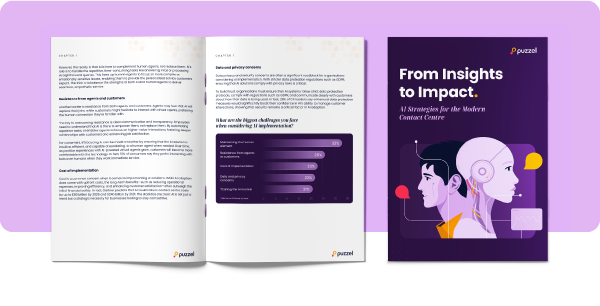
What are the biggest challenges you face when considering AI implementation?
-
33% Maintaining the human element
-
26% Resistance from agents or customers
-
23% Cost of implementation
-
22% Data and privacy concerns
-
21% Training the AI models
What CX leaders need from AI to boost confidence
AI has come a long way in customer service, but for many, there’s still room for improvement to fully meet expectations. Here’s a look at the additional AI capabilities that would create more confidence across the board:
Improved understanding of complex language
A deeper understanding of complex language is at the top of the list. According to our survey, 35% of CX leaders believe that improving AI’s ability to interpret complex queries would significantly boost their confidence in its ability to handle customer interactions. Misunderstood queries or incomplete responses frustrate customers, undermining trust in AI tools. With a better grasp of natural language, AI can provide more accurate and helpful responses, reducing the need for agent intervention and improving overall customer satisfaction.
Improved automated escalation to human agents
Seamless escalation to human agents is another critical need. Even the most advanced AI systems encounter situations they cannot resolve, and customers expect a smooth handover when this happens. A seamless transition—where customers don’t have to repeat themselves or endure delays— is key to maintaining trust in AI and the overall experience. In fact, 34% of CX leaders highlight better automated escalation processes as a capability that would make them more confident in using AI.
Greater emotional intelligence and empathy
Customers want to feel heard, especially during sensitive interactions, and AI’s lack of emotional intelligence can be a significant barrier. About 32% of CX leaders believe that greater emotional intelligence and empathy in AI responses would boost their confidence in the technology. While AI excels at speed and efficiency, incorporating a more human- like understanding of tone and context could elevate its role in handling complex, emotionally charged scenarios.
Better integration with existing systems
30% of CX leaders believe that better AI integration with existing systems would make them more confident. On the other hand, half of CX leaders report that their current contact centre solutions integrate easily with third-party applications, such as CRM systems and AI tools. However, 26% still face difficulties achieving seamless integration. Improved integration is seen as an important aspect, with 30% of CX leaders—rising to 36% for mid-sized organisations—believing it would boost their confidence in AI.
What additional AI capabilities would make you more confident in its ability to handle customer interactions?
-
35% Improved understanding of complex language
-
34% Improved automated escalation to human agents
-
32% Greater emotional intelligence and empathy
-
30% Better AI integration with existing systems
-
28% Better data protection measures
Trend 6: Human + AI collaboration
As AI continues to play a larger role in customer service, one question looms large: Will AI replace human agents entirely? While this concern sparks debate, the reality is far more balanced.
According to our research,
43% of CX leaders believe the future lies in a hybrid model, where AI and humans work together.
This sentiment grows even stronger for businesses with 500-999 employees, with 50% supporting this view. Meanwhile, 29% of leaders predict humans will remain central in customer service, and only 15% think AI will fully take over routine tasks.
Customers may expect fast resolutions, but they still value the human connection—especially during complex or sensitive interactions. That’s why balancing AI with human expertise is so important, especially with a third of CX leaders saying their biggest concern when considering AI implementation is losing the human touch. The key lies in using AI to handle repetitive tasks while enabling human agents to focus on moments that matter most: empathetic, high-value customer interactions.
Moreover, one of the most compelling benefits of AI is how it empowers agents. By automating routine tasks, AI reduces the administrative burden, giving agents more time to focus on strategic and meaningful work. This not only boosts productivity but also enhances job satisfaction by allowing agents to fully utilise their skills.
Research from Harvard supports this approach, showing that organisations achieve the best results when humans and machines work together. While AI excels at speed and efficiency, human agents bring empathy, understanding, and emotional intelligence—the critical ingredients for building meaningful, long-lasting customer relationships. And this matters, as customers want the personal touch in customer interactions.
RELATED CONTENT
Human + AI collaboration: The dream team for customer support.
Here’s a closer look at some other trends that will define the future contact centres:
-
Upskilling agents to be high-skilled AI engineers
As AI becomes a bigger part of the picture, agents will need to upskill to work alongside these new technologies. They’ll be trained to use AI tools, analyse customer data, and make real-time decisions that drive better customer outcomes.
-
Greater focus on emotional intelligence
With AI handling technical and routine tasks, agents will focus more on interpersonal skills, empathy, and understanding. Emotional intelligence will become a key differentiator in delivering standout customer experiences.
-
Generative AI for highly personalised experiences
AI will help agents create more personalised interactions and content on the spot. Whether it’s recommending products or offering tailored solutions, generative AI will allow agents to respond in ways that feel natural and relevant to each customer.
-
Voicebots that can handle complex calls
Voicebots are moving beyond basic tasks. They’ll be able to handle more complex queries, like troubleshooting issues or making changes to accounts, all while maintaining a natural, conversational flow. This means fewer calls will need to be escalated to human agents, saving time and improving efficiency.
-
AI-powered insights for smarter decisions
As customer interactions happen, AI will analyse conversations in real-time and provide immediate insights to agents. This means issues can be spotted early and resolved before they escalate, leading to happier customers and more informed decision- making by managers.
Conclusion
As contact centres continue to evolve, the strategic role of CX leaders has never been more crucial. As they tackle challenges head-on, they’re shaping the future of customer service—one that prioritises efficiency, empowers agents, and meets rising customer expectations.
From AI-driven voicebots to intelligent automation, CX leaders are using technology to streamline workflows, reduce burnout, and enhance customer satisfaction. They’re staying ahead of the curve, proactively adapting to an ever-changing landscape.
The future of CX is all about balance. By combining the power of AI with the human touch, CX leaders can drive efficiency while maintaining the personal connections customers value. With the right approach, AI will become a vital tool to improve service and meet the growing demands of the modern customer. The key lies in creating a hybrid model where AI handles routine tasks, freeing agents to focus on what matters most—building trust and solving complex issues with empathy.
Set your contact centre up for success. How Puzzel can help
Customer expectations are higher than ever. Our mission is to ensure you have the right tools to exceed them. As you prepare for the future of CX, our AI-powered CX ecosystem unifies interactions and simplifies daily tasks in your contact centre, helping you address challenges like agent turnover and complex queries, enabling your team to do more with less.
Unlock 278% ROI
The recent Forrester Total Economic Impact Study of Puzzel revealed that a composite organisation representative of interviewed customers experienced benefits of €12,98M and an ROI of 278% over three years by deploying Puzzel’s CX solutions.
AI bots
Take some stress off your agents’ shoulders. Use AI- powered chatbot, voicebot and emailbot to handle routine tasks and boost self-service, freeing your agents to focus on high-value, complex tasks. Boost agent productivity
By integrating channels and providing training, contact centres experienced a 15% boost in agent productivity and 163% improvement in agent retention, driving business gains of €10.3 million over three years, by deploying Puzzel, according to the recent TEI study of Puzzel.
Unified platform
The Puzzel CX Ecosystem helps you consolidate
all your contact centre technologies into a single platform, so your agents can focus on what matters most – providing delightful customer experiences, regardless of channel.
Unlock your team’s full potential.
Explore how Puzzel can help and learn more by visiting our website: puzzel.com