
How does the Puzzel CX ecosystem enable AI-driven omnichannel service?
Most contact centres are running AI experiments. Fewer are running AI at scale. The difference almost always comes down to the platform underneath — whether channels share data, whether AI is native or bolted on, and whether agents can work from one place instead of five. This article explains how the Puzzel CX ecosystem is built to close that gap.
TL;DR
Core idea: Puzzel CX ecosystem is a modular, AI-native omnichannel platform designed to fix fragmented contact centre tech—where multiple systems cause lost data, poor AI performance, and inefficient agent workflows.
-
The problem it solves: Most contact centres use ~4 disconnected systems, leading to context loss, agent inefficiency, and weak AI outcomes—only a small minority operate on a fully unified platform.
-
Unified omnichannel + workspace: Puzzel brings voice, chat, email, social, and messaging into one interface, with full customer context carried across channels—reducing repetition, improving routing, and lowering agent workload.
-
AI that supports agents: Built-in tools like Co-Pilot, Live Summary, and Conversational Intelligence provide real-time guidance, automation, and insights, helping agents work faster while improving quality and reducing training time.
-
Automation + operations in one system: Includes Virtual Agents (self-service), Workforce Management, Case Management, and Knowledge Management, enabling organisations to scale efficiently without adding headcount or extra tools.
The problem with fragmented contact centre technology
Only 3% of contact centres operate on a single, unified platform. The average organisation manages 3.9 different contact centre technologies — each with its own data, its own interface, and its own limitations.
That fragmentation shows up everywhere. Agents switch between systems mid-call. Customer context gets lost at channel handoffs. AI deployments struggle to deliver value because they are pulling from disconnected data sources. And while 85% of CX leaders say they feel ready for AI, only a third feel fully prepared when it comes to the data readiness and integration depth that AI actually requires.
The result is contact centres that are technically sophisticated but operationally fragmented. More solutions, but not a better experience.
That is the problem the Puzzel CX ecosystem is designed to solve.
What the Puzzel CX ecosystem is
The Puzzel CX ecosystem is a modular, AI-native platform that brings every channel, customer, and agent together in one place. It covers the full range of what a modern contact centre needs — omnichannel routing, AI-powered agent support, self-service automation, workforce management, quality management, and knowledge management — all built to work together rather than alongside each other.
The ecosystem is organised into three areas.
Contact centre — the core omnichannel platform that routes voice, email, chat, social, SMS, and messaging to the right agent or automated process, with full interaction history visible in a single agent workspace.
AI-powered experiences — the solutions that use AI to improve every conversation: before it starts, while it is happening, and after it ends. This includes Conversational Intelligence, Live Summary, Co-Pilot, Virtual Agent Suite, and Quality Management.
Operational excellence — the solutions that keep your team running efficiently at scale: Workforce Management, Case Management, and Knowledge Management.
Each module is available individually. You can start with the contact centre core and add AI capabilities when your team is ready. You can deploy Virtual Agents before expanding into workforce management. There is no requirement to buy the full suite at once, and no need to re-platform as your requirements grow. Puzzel's modular design means you move at the pace your organisation can absorb — without disruption, and without starting again.
The omnichannel foundation
Effective omnichannel service is not about supporting multiple channels. It is about making sure context travels with the customer across every one of them.
Only 7% of contact centres today deliver truly seamless cross-channel transitions. That gap is where customer effort accumulates, repeat contacts climb, and trust erodes. Customers expect agents to know their history. When context is lost at a channel handoff, the customer notices — and the agent is left starting from scratch.
Puzzel's Contact Centre brings voice, email, chat, social, SMS, WhatsApp, and co-browsing into a single agent workspace. Intelligent routing directs each interaction based on agent skills, customer history, and current queue conditions. When a customer moves from chat to voice, their context moves with them. Agents see the full interaction history the moment a conversation begins — not a summary, the actual thread.
The agent workspace is built to reduce cognitive load. Rather than toggling between systems, agents manage every interaction from one interface, with AI support sitting alongside them rather than in a separate application.
AI that supports agents, not replaces them
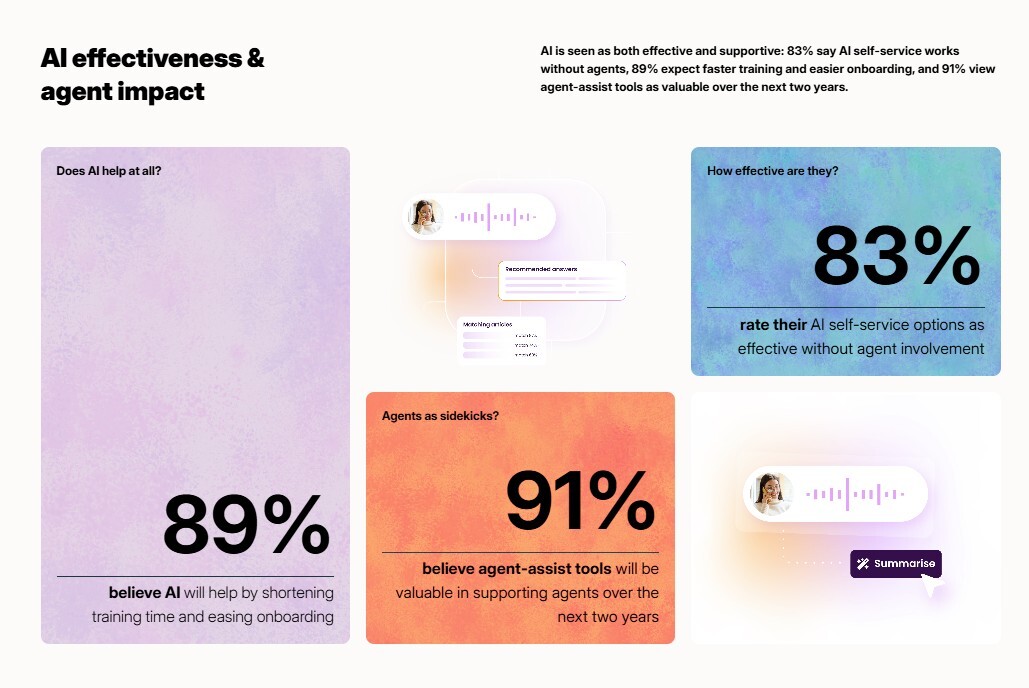
Puzzel's 2026 State of Contact Centres report, which surveyed 1,505 CX leaders across Europe, found that 91% believe agent assist tools and AI copilots will be valuable in supporting agents over the next two years. That finding reflects where AI investment is actually delivering results — not in full automation of every interaction, but in reducing the cognitive burden on agents handling complex ones.
Puzzel's AI solutions are built around that principle. AI that makes service easier, not more complicated:
Co-Pilot listens to live calls, understands context in real time, and surfaces relevant answers, suggested next steps, and process guidance directly on screen. Agents do not need to break concentration to search a knowledge base mid-conversation — the right information appears when it is needed. Nearly half of CX leaders surveyed in 2026 say new agents now reach full working confidence within two to four weeks, a shift driven directly by real-time guidance of this kind.
Live Summary automatically captures and summarises each conversation as it happens, removing the manual note-taking that typically adds several minutes to every after-call wrap. Agents stay focused on the customer during the call, not on documentation afterwards.
Conversational Intelligence uses natural language processing and machine learning to automatically transcribe, tag, and analyse customer interactions across channels. It surfaces patterns in customer intent, identifies recurring issues, tracks sentiment trends, and highlights where call handling can be improved. Telmore uses Conversational Intelligence to save 400 hours per month — replacing manual call tagging with automated analysis and giving their team data to act on rather than data to create.
Quality Management uses AI to automatically score interactions against your defined quality criteria, flag coaching opportunities, and maintain compliance consistency — without requiring a dedicated team of analysts to review every call manually.
Together, these solutions create a feedback loop: every conversation makes the next one better.
Self-service that handles volume without adding headcount
83% of CX leaders say their self-service options are effective without agent involvement. That reflects a genuine shift in how virtual agents are designed — no longer simple FAQ bots, but AI agents capable of understanding intent, handling multi-step processes, and escalating to a human agent when the conversation genuinely requires it.
Puzzel's Virtual Agent Suite covers chat, voice, and email channels. The virtual agents understand natural language, can handle routine queries and process-driven interactions end to end, and include anti-hallucination safeguards to ensure responses are accurate and grounded in your business data.
Agentic AI capability within the suite allows virtual agents to identify knowledge gaps automatically — surfacing areas where customers are asking questions the system cannot yet answer well, ranked by query volume, so your team knows where to focus knowledge investment first.
When a virtual agent reaches the limits of what it can handle, handoff to a human agent carries the full conversation context. No customer has to repeat themselves. No agent starts a conversation blind.
Workforce management and operational intelligence
Customer volumes are rarely predictable. Seasonal peaks, product launches, service incidents — contact centres need the flexibility to respond quickly without burning out agents or carrying excess capacity.
Puzzel's Workforce Management solution handles scheduling, forecasting, and capacity planning. It gives operations leaders the visibility to match staffing to demand, manage schedule adherence, and identify where performance is drifting before service levels are affected.
Case Management brings all open interactions and enquiries into one place, supporting the longer-resolution workflows that do not close within a single conversation — particularly relevant for organisations in public sector, utilities, and insurance where interactions span days or weeks.
Knowledge Management structures your organisation's knowledge so that agents and virtual agents always have access to accurate, current information. Rather than a static internal resource, it is a live knowledge layer that feeds Co-Pilot, Virtual Agent Suite, and agent-facing search simultaneously — so the same answer is available to a virtual agent at 02:00 and a human agent at 14:00.
The data behind the platform
The Forrester Total Economic Impact study of Puzzel (2024) provides the clearest picture of what the ecosystem delivers in practice. Forrester interviewed four Puzzel customers and constructed a composite European organisation managing around three million interactions per year across voice, email, and messaging channels, with 750 agents.
The findings:
- 278% ROI over three years
- €12.98M in total benefits versus €3.43M in costs
- Net present value of €9.55M
- Average handling time reduced by nearly 50 seconds per interaction
- Agent tenure at one UK insurance customer increased from under six months to 3.5 years, following the introduction of skill-based routing and modular training enabled by Puzzel
That last finding matters as much as the financial ones. Agent attrition is one of the highest-cost operational challenges in contact centres. When agents have better guidance, less administrative burden, and more varied work, they stay longer — and the quality of customer experience improves alongside them.
For NRLA, Puzzel cut written response times by 86%. These are not projections: they are results from European organisations using the platform at scale today.
Built for European compliance
Puzzel's infrastructure is hosted entirely in Europe. GDPR compliance and alignment with the EU AI Act are built into the platform's architecture, not managed through contractual addendums to a service hosted elsewhere.
For organisations in regulated industries — banking, insurance, energy, and public sector — the ability to consolidate onto a compliant, European-hosted platform is not a preference. It is a governance requirement. 94% of CX leaders in the 2026 State of Contact Centres report identified tech stack consolidation as essential to their strategy. The Puzzel CX ecosystem is designed to be the platform that consolidation leads to, not away from.
Frost & Sullivan recognised Puzzel as both an Innovation and Growth Leader in its 2025 EMEA Customer Experience Platforms Frost Radar, noting its well-balanced approach to secure AI innovation, human empathy, and regulatory compliance across European markets.
Starting where you are
The Puzzel CX ecosystem serves more than 550 enterprise customers across Europe, including organisations in retail, travel and hospitality, public sector, energy and utilities, banking, and insurance. With 25 years in contact centre and 39% of its full-time employees dedicated to R&D, the platform evolves continuously — and customers benefit from that investment without having to manage it themselves.
You can begin with the Contact Centre module and add AI capabilities when your team is ready. You can pilot Co-Pilot with a group of agents before rolling it out more broadly. You can deploy Virtual Agents on chat first and extend to voice and email later. Each module integrates with the others. None requires the others to function.
That is what modular and AI-native means in practice: not a marketing claim about flexibility, but a platform architecture that lets your contact centre grow without re-platforming, without disruption, and without starting again.
Frequently asked questions