
How can smarter quality assurance help you win evaluations?
How AI-powered quality assurance and call recording are reshaping enterprise contact centre selection in the Nordics.
Enterprise contact centres are at an inflection point. Nordic CX leaders are no longer asking whether to modernise — they're asking which vendor can deliver the outcomes that matter most: unified systems, intelligent quality assurance, and measurable impact on agent performance and customer experience.
The competitive landscape has shifted. When enterprise evaluations happen, the platforms that win are those that solve the Nordic CX challenge head-on: simplifying technology stacks, embedding AI that genuinely supports agents, and delivering real control over quality and compliance without creating new complexity.
TL;DR
- AI-powered quality assurance transforms contact centres: Nordic enterprises are replacing manual QA with AI-driven quality assurance that scores 100% of interactions, improves compliance, and delivers real-time insights for better agent performance and customer experience.
- Unified contact centre platforms reduce complexity and costs: With organisations managing multiple systems, demand is rising for omnichannel, fully integrated platforms that streamline operations, improve data consistency, and eliminate costly tech stack fragmentation.
- Integrated call recording enables compliance and actionable insights: Modern call recording solutions with transcription, searchability, and GDPR-compliant data management turn conversations into valuable, audit-ready data that feeds QA and coaching workflows.
- AI copilots enhance agent productivity and CX outcomes: Enterprise buyers prioritise AI that supports agents with real-time guidance, sentiment analysis, and knowledge surfacing—reducing cognitive load and improving resolution speed.
- Enterprise CX evaluations prioritise measurable impact and scalability: Vendors win in the Nordics by delivering AI-native architecture, automated QA, and modular, scalable solutions that improve efficiency, accelerate onboarding, and drive ROI.
The Nordic CX challenge
Data from Puzzel's 2026 State of Contact Centres report reveals a decisive picture: Nordic CX leaders are drowning in complexity. The average organisation now manages nearly four different contact centre systems, and that fragmentation is costing them.
Half of respondents report that multiple vendors inflate support and maintenance costs. Almost as many struggle with data consistency and integration challenges. Yet 94% of CX leaders say consolidation is essential to improving efficiency and performance — and they're right.
This is the environment where contact centre evaluations happen. CX leaders are looking for platforms that simplify, not add to the chaos. They want tools that talk to each other. They need quality assurance that doesn't require a separate team to manage it. And they increasingly expect AI that works with agents, not around them.
What enterprise evaluations look for
Modern enterprise contact centre evaluations assess three interconnected areas: technology architecture, AI integration depth, and operational readiness. Within those, specific capabilities determine which vendors advance and which fall away.
Unified platform capabilities
Enterprise evaluators prioritise vendors that provide omnichannel routing, native support for voice, chat, email, and social messaging, and shared customer context across all interactions. Agents must see the same unified history; systems must integrate without lengthy custom builds.
Quality assurance at scale
This is where differentiation happens. Evaluators assess whether a platform delivers:
-
Automated quality assurance that scores 100% of interactions without expanding the QA team.
-
Integrated call recording with comprehensive transcription and searchability.
-
Real-time compliance monitoring and audit-ready documentation.
-
Coaching workflows that translate QA findings directly into agent development.
AI that supports agents
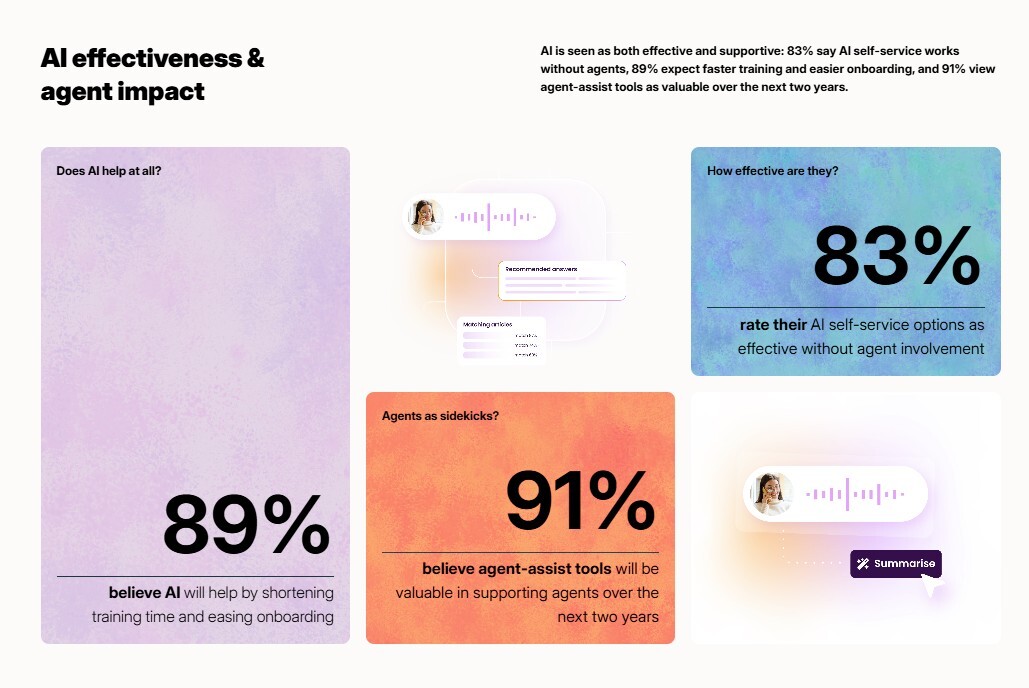
Enterprise buyers are moving away from automation for its own sake. They want copilots — real-time guidance, sentiment cues, and knowledge surfaces that reduce cognitive load. The data supports this shift: 91% of CX leaders believe agent-assist tools will be valuable in supporting agents over the next two years. Only those vendors that embed AI as a foundational agent support layer, not a bolt-on, will win.
AI-powered quality assurance: The winning differentiator
Manual quality assurance doesn't scale. When a contact centre operates on a sample of 10–15% of interactions, quality gaps go undetected. Risk accumulates. Consistency suffers.
Modern enterprise contact centres need to see everything. They need AI that transcribes calls, detects sentiment, flags compliance gaps, evaluates agent behaviour against custom rubrics, and delivers scores in real time — all without a proportional expansion of the QA team.
When evaluators assess quality assurance capabilities, they're looking for platforms that deliver:
-
Complete coverage — 100% interaction scoring, not a sample-based snapshot
-
Consistent evaluation — AI-calibrated scoring removes subjective judgment variance
-
Actionable insights — Automated scoring connects directly to coaching workflows and performance improvement
-
Compliance assurance — Real-time risk detection and audit-ready documentation for regulated industries
Call recording: Foundation for insight
High-quality call recording is not optional in enterprise contact centres — it's a prerequisite. But it's not just about capturing conversations. Modern enterprise buyers evaluate vendors on their ability to make recordings useful: searchable, secure, compliant, and tightly integrated with quality assurance, coaching, and reporting workflows.
Nordic organisations are particularly rigorous on this front. With GDPR compliance non-negotiable and data residency expectations high, evaluators assess whether vendors provide:
-
EU data residency for recorded interactions, with transparent encryption and storage policies
-
Automated transcription with searchable indexed content — conversations become discoverable data
-
Consent and retention management that keeps them audit-ready without manual overhead
-
Integration with QA and sentiment analysis — recordings feed directly into quality evaluation and coaching
When call recording is built natively into the platform architecture, not bolted on, it becomes invisible — it just works. And that simplicity is exactly what Nordic CX leaders are looking for.
The data: Why this matters
Enterprise decisions don't happen in a vacuum. They're shaped by data — evidence that a platform will deliver measurable outcomes.
The 2026 State of Contact Centres research provides compelling evidence for why simplified, AI-native platforms with strong quality assurance capabilities are winning evaluations:
|
Finding |
Implication |
|
94% of CX leaders say consolidation is important for improving performance |
Unified platforms without fragmentation win evaluations |
|
91% say agent-assist tools will be valuable |
AI that supports agents, not replaces them, is table-stakes |
|
89% believe AI will shorten onboarding and training |
Faster time-to-productivity and improved agent experience = ROI multiplier |
|
|
|
Why enterprise evaluations are shifting
Five years ago, enterprise contact centre evaluations were about feature checklists and cost-per-seat. Today, they're about architectural coherence, integration depth, and governance maturity. Three shifts explain this change:
1. Tech stack consolidation is now strategic
Organisations managing 3.9 contact centre systems on average are paying a heavy tax in maintenance costs, data silos, and lost agility. Enterprise buyers now treat stack simplification as a critical success factor. Vendors that deliver omnichannel capabilities, workforce management, quality assurance, and AI co-pilots within a single unified platform have a structural advantage in evaluations.
2. Quality assurance must be automatic and comprehensive
Legacy quality assurance — human spot-checking 10% of calls — is no longer fit for purpose. Evaluators now prioritise platforms where AI-powered quality assurance is embedded from the ground up. 100% interaction coverage, consistent scoring calibrated to your rubrics, real-time compliance alerts, and automated coaching triggers are now the baseline expectation.
3. AI is evaluated on human impact, not automation ambitions
Vendors pitching AI as a replacement for agents are losing ground. Enterprise evaluators now assess AI on its ability to support agents in real time: reducing cognitive load, surfacing knowledge, flagging sentiment, and enabling faster resolution. Platforms where AI is positioned as an agent copilot—not a replacement—are winning.
This is a fundamental reorientation. It's not about AI doing more. It's about AI helping agents do better.
How platforms win Nordic enterprise evaluations
The platforms that are winning enterprise evaluations across the Nordics share a common architecture. They don't patch AI onto legacy systems. They don't fragment quality assurance into a separate tool. They don't force choosing between agent support and automation.
Instead, winning platforms deliver:
-
A truly unified architecture for voice, digital, workforce management, and quality assurance — no integration tax.
-
AI-native quality assurance that scores every interaction against your rubrics in real time, with calibration and coaching workflows built in.
-
Call recording integrated natively with transcription, searchability, GDPR compliance, and consent management.
-
AI copilots that reduce agent cognitive load by surfacing knowledge and sentiment in real time.
-
Modular pricing and deployment that lets enterprises start with what they need and grow without rip-and-replace.
These aren't nice-to-have differentiators. They're the baseline of what enterprise evaluators now expect.
The future of Nordic CX is simple
Nordic CX leaders are clear about what they want: simpler systems, smarter automation, stronger agent support. Enterprise contact centre evaluations are now the arena where these priorities play out.
AI-powered quality assurance and integrated call recording are no longer differentiators — they're table-stakes. What matters now is architectural maturity: how deeply are QA and recording integrated into the platform? How comprehensive is the coverage? How seamlessly does quality data flow into coaching and agent development?
The platforms that win Nordic enterprise evaluations in 2026 and beyond won't be the ones with the most features. They'll be the ones that eliminate friction — unified systems, intelligent quality assurance, and AI that genuinely supports agents.
For enterprise buyers, that clarity is everything. For vendors, it's a clear signal about what needs to be built.
Frequently Asked Questions
The reality: when you're only reviewing 10–15% of your interactions, quality gaps stay hidden. That's where risk accumulates — and where customers notice inconsistency.
AI-powered quality assurance scores 100% of your interactions, which means you catch compliance gaps in real time, not after damage is done. Your QA team doesn't grow; your coverage does. Instead of spending hours manually spot-checking calls, they focus on coaching and agent development — the work that actually improves performance.
For enterprise buyers, this shifts QA from a compliance checkbox into a coaching engine. Every interaction feeds into agent development workflows. Your rubrics are applied consistently, without subjective variance. And when something matters — a compliance flag, a customer sentiment shift, an agent struggling with product knowledge — you know immediately.
That's not just better oversight. That's better agents.
The problem: your current tech stack has separate tools for recording, transcription, QA scoring, and coaching. Data moves between systems. Integrations break. Your team spends more time wrangling tools than improving performance.
When call recording is native to your platform — not bolted on — it just works. Recordings are automatically transcribed and searchable. Compliance workflows run in the background. QA scores feed directly into coaching workflows. Your agents see what they need to improve without context-switching through five different systems.
For enterprise organisations, native integration means:
- One source of truth. Every interaction, every score, every coaching action lives in one place.
- Faster insights. Instead of manually extracting data from separate systems, your QA team works with ready-to-use dashboards and automated triggers.
- Real GDPR compliance. EU data residency, automated consent management, and audit-ready documentation built in — not added on.
The result? Your team spends less time managing tools and more time improving conversations.
Evaluators aren't looking for features. They're looking for architectural maturity.
Winning platforms share three things:
Unified architecture. You're not patching AI onto legacy systems or managing separate point solutions for voice, digital, QA, and workforce management. Everything works together — one platform, one integration, one data layer. That's what simplifies your tech stack.
AI that supports agents, not replaces them. Vendors pitching AI as a replacement for agents are losing. Enterprise buyers want copilots — real-time guidance, sentiment cues, knowledge surfaces that reduce cognitive load and help agents resolve faster. AI should make your team's job easier, not put them at risk.
Measurable outcomes, not feature lists. Evaluators assess whether a platform delivers business results: faster onboarding, fewer compliance risks, better agent retention, measurable ROI. That means modular deployment, clear pricing, and proof of impact — not all-or-nothing purchases.
For Nordic enterprises especially, there's a fourth factor: simplicity. Your platform should reduce complexity, not add to it. That's not a feature request. That's table-stakes.